
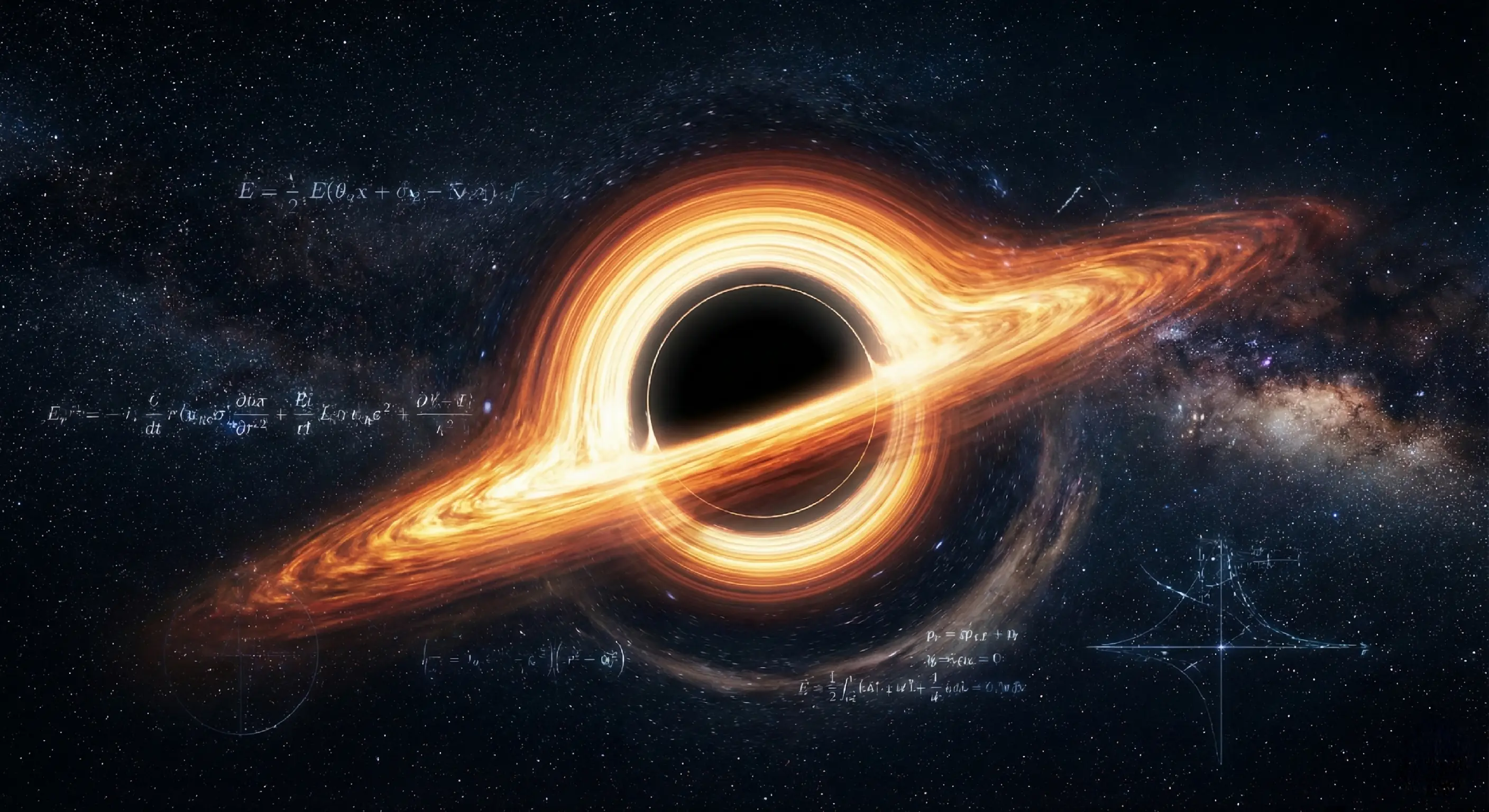
Everyone who follows a little bit of Physics and Astronomy must have already heard the word 'Singularity'. Mainly, the word Singularity is usually heard in two contexts. One, in connection with Black Holes. Then, in connection with the Big Bang.
A Black Hole is an object with a gravitational field so strong that even light cannot escape it. Even Black Holes with millions of times the mass of our Sun exist in the universe. The entire mass of a Black Hole is concentrated in a single point in its center. The volume of that point is zero. Therefore, its density is infinity. That point is generally called the Singularity. It is also called Gravitational Singularity.
Similarly, according to the Big Bang theory, the entire universe we see today was compressed into a very small point 13.8 billion years ago. It is from that state that it expanded step-by-step to reach the state we see today. The state 13.8 billion years ago, which was very small, extremely hot, and had high density, is called the Big Bang Singularity.
So, relating to Black Holes and the Big Bang, the word Singularity is commonly used in Physics. Naturally, the concept that a huge amount of mass or matter is compressed into a very small place is what we call a Singularity, this is an idea that might have formed in all our minds.
But the meaning of the word Singularity is not exactly this. The dictionary meaning of the word Singularity is unique, peculiar, special, or rare, special, strange, etc. Only when speaking in connection with Physics does it get the meaning of having infinite density. But for a Singularity to exist, it is not necessary to have infinite density.
For example, the poles of our Earth are often considered a type of Singularity. This is categorized as a Coordinate Singularity. Similarly, the sharp tip of a water droplet can be considered a type of Singularity. But in none of these places is there a situation where a huge amount of mass is compressed into a very small place.
Leave all that aside, recently, with the arrival of artificial intelligence like Chat GPT, there is propaganda that we are moving towards a Singularity, and if this trend continues, we will reach a Singularity before long.
When we hear all this, we might start feeling that this Singularity is not the thing we assumed it was until now. So then, what exactly does Singularity mean? Is the state said to be inside a Black Hole, meaning the mass of millions of suns compressed into a point with zero volume and infinite density, actually possible? Is the object called a Singularity actually a possible state in the real world?
From Math to Physics
The word Singularity is actually a word used in Mathematics. From Math, this word reaches Physics. Although this word is used in Physics only in very special circumstances, in Mathematics, Singularity has a slightly broader meaning. The circumstances where a mathematical formula or a function does not have a clear answer are called Singularity in Math.
For example, f(x) = 1/x is a simple mathematical function. The meaning of this function is that the value of f(x) is the inverse of whatever the value of x is. If the value of x is 2, the value of f(x) is 1/2. If the value of x is 5, the value of f(x) is 1/5. Like that. In this function, at the time when the value of x becomes zero, it becomes 1/0. We have learned in school long ago that dividing any number by zero results in infinity. According to that, the value of 1/0 should be infinity.
However, that is not entirely correct. Today, if we try typing 1/0 in a computer, the answer we get won't be infinity. We get "Undefined." It means that dividing one by zero does not result in a defined answer, or it has not been defined.
The logic for saying 1/0 is infinity relies on a specific logic in calculation. In the previously mentioned function f(x) = 1/x, if the value of x is 10, the value of f(x) is 0.1. When the value of x becomes 1, the value of f(x) is 1. But if the value of x decreases below one, meaning if it becomes 0.1, the value of f(x) is 1/0.1, which is 10. When x becomes 0.01, the value of f(x) becomes 1/0.01, which is 100. When the value of x becomes 0.001, the value of f(x) becomes 1000. As the value of x gets smaller and smaller, the value of f(x) gets bigger and bigger. So, as the value of x becomes the smallest value, zero, the logic is that the value of f(x) will become the largest value, infinity. That is the logic of saying 1/0 is infinity.
But this logic is not entirely correct. Because suppose we gave a negative value to x. That is, -0.001. If negative values come like this, when we reach zero, the value of f(x) will be found to be minus infinity. So, at the time when the value of x becomes zero, the value of f(x) could be plus infinity or minus infinity. That is why the value of 1/0 is said to be "Undefined" or cannot be defined. So, in the function 1/x, at the place where the value of x becomes zero, it is said that there is a Singularity.
Simply put, Singularity is another way of saying that we do not know what the answer to 1/0 is. Therefore, we must understand that on occasions where the value of x becomes zero, the function 1/x cannot be used.
However, usually, this word is used on occasions where the value of a formula becomes successively larger.
In Mathematics, if a situation of Singularity arises in a formula, the practice is to nicely avoid that state. Because, thinking that we don't know how that function behaves at that point, usually, serious problems do not arise in Mathematics.
But in Physics, every equation indicates some real-world phenomenon. When that happens, if a Singularity appears in such formulas, understanding what its correct meaning is in a practical sense is a headache for scientists.
Gravity and Singularity
For example, according to Newton's gravitational theory, the formula to find the gravitational force between two objects is F = G(m1m2)/r². In this, r is the distance between these two objects. It is in the denominator of this formula. If ever a state comes where the value of this r becomes zero, a situation arises where we divide by zero in this formula. Then, according to the formula, a state arises where the strength of the gravitational force becomes infinity. Or, a Singularity occurs.
But just like we do in Mathematics, we cannot ignore or overlook this Singularity. Because gravity is not an event confined to a formula. It is a real phenomenon. If we calculate the value using the formula and a Singularity appears, does that mean that in that circumstance the strength of gravitational force will become infinity? If one asks if any force can practically have infinite strength, it is a confusing question.
Generally, in this formula, the circumstance where r or distance becomes zero does not usually happen. Because r is the distance between the centers of mass of these two objects. The objects come closest together when they are touching each other. Even then, the distance between their centers will not be zero.
But we know that all objects are made of atoms. When we say two objects are touching, it means the atoms on the outermost part of this object and the atoms on the outermost part of that object are touching. An atom means there is a nucleus in the middle and electrons revolving around it. The size of the area where these electrons revolve is calculated as the size of an atom. If the size of an atom is the size of a football ground, the nucleus is only as big as a small pebble placed in the middle. Electrons are considered as points with absolutely no size. So, 99.9999% of the space inside every atom is emptiness.
Still, the reason one atom does not enter another atom is due to the repulsive force between the electrons of these two. When we say the previously mentioned two objects are touching, the reason this object does not enter inside that object is due to the electron repulsion of the atoms in both. That is why the distance r usually does not become zero.
However, in circumstances where gravitational force becomes extremely strong, gravity will overcome the repulsive force of the electrons. That is the state where gravity overcomes Electron Degeneracy Pressure. In such a situation, this small object will enter inside the large object, and not only that, the large object itself will shrink greatly. The electrons inside that object will shrink into the nucleus of the atoms.
When that happens, the areas where electrons were revolving will now become empty space. The nuclei of all atoms will join together. At that time, this object will shrink to 1/100000 of its original volume. This is the state in a Neutron Star. We have discovered Neutron Stars in the universe. Therefore, it is not a hypothetical situation.
But even in Neutron Stars, a situation where the entire mass shrinks into a single point has not been reached. What prevents that is the degeneracy pressure of neutrons. If a situation arises where gravity overcomes that too, we will reach a state where the distance r mentioned earlier becomes zero. At that time, according to Newton's gravitational formula, a state arises where gravitational force becomes infinite.
According to Einstein's General Theory of Relativity field equations, in this situation, space-time curvature becomes infinity. Thus, the state where dividing by zero occurs in both these formulas, or a Singularity occurs, is this. This is the Gravitational Singularity said to be inside a Black Hole.
In this situation, there is no doubt that the strength of the gravitational field will be terrifying. However, simply because we thought that a Singularity is occurring in these two formulas, is it compulsory that such a Singularity must occur in the real world?
A Matter of Perspective
Let's take the case of a water droplet. Water droplets usually have a round shape. That is, its surface has a curvature. We can make a formula to calculate the various forces acting inside the droplet and find this curvature utilizing the diverse forces acting within the drop. As the water droplet starts to drip from a tap, a sharp part appears at its top. According to the formula we made, the curvature of this sharp part is infinity. That is, its sharpness is infinite. A Singularity occurs at this point for the formula for calculating curvature.
But in reality, it is never possible for this water droplet to have a point with infinite curvature. The mistake that happened to us here is that when making this formula, we imagined that the water inside the water droplet is a single liquid. However much it is, water is made of water molecules. Therefore, at this sharp part, at the very least, there will be one water molecule. So, the curvature of that molecule is the curvature of this sharp part. Other than that, it will never become infinity. A sharpness as small as a molecule is the maximum possible at this point. Infinite sharpness is not possible.
So, when we consider water as a collection of molecules, the Singularity disappears in this case. Just like we changed our perspective on a phenomenon, an example of a Singularity disappearing was just mentioned.
In the picture showing the space-time curvature created by a Black Hole, there is a point with infinite curvature similar to the water droplet. That is the Gravitational Singularity described by the General Theory of Relativity dealing with the center of a Black Hole. But just like in the case of the water droplet, we cannot avoid this Singularity in the case of gravity. The reason is that we represented water as molecules, the smallest unit of water, right? But does gravity have such a smallest unit? We do not know.
Because there is no theory today explaining gravity in detail. To explain gravity, the theory we use today is the General Theory of Relativity. But in situations where Singularity comes, this theory does not work effectively, is what many scientists believe. In those circumstances, instead of that theory, what should actually be used is another theory. But since there is no such theory concerning gravity that works at such a small level, looking at it through the existing theory creates a Singularity is the only issue.
Conclusion
We have actually discovered real Black Holes in our universe. So then, where does the question of whether a Gravitational Singularity exists stand? We must understand that for a Black Hole to form, a Gravitational Singularity is not necessary. If the entire mass of an object shrinks inside the Schwarzschild radius of that object, it has become a Black Hole. Once it becomes a Black Hole, inside its Event Horizon, what is it? We have no way to know.
Regarding a Neutron Star, its Schwarzschild radius will be slightly below its surface. Therefore, it will not be a Black Hole. We can see it. But suppose we add more matter to a Neutron Star bit by bit. Then its mass increases. Along with that, gravity increases. Due to this excess gravity, it shrinks. Along with that, its Schwarzschild radius starts increasing. Thus, at one stage, the entire matter of the Neutron Star comes inside its Schwarzschild radius. With that, it became a Black Hole. That Schwarzschild radius is what later becomes its Event Horizon.
Once it becomes an Event Horizon, then we have no way to know what is happening inside. Inside that Event Horizon, does this old Neutron Star still exist? Or did all the matter inside it shrink into a single point? We do not know.
By the time we reach that state, the gravity will be extremely powerful. A force capable of withstanding such powerful gravity has not been discovered yet. Therefore, we can assume that the matter inside it will shrink into a single point. Naturally, a point with zero volume and infinite density must exist. But when reaching such a small state, Quantum Theories become prominent. There is no theory explaining gravity in Quantum Mechanics. The existing theories concerning gravity are the ones we currently have. But in situations where Singularity comes, these theories do not work effectively, is what many scientists believe.
According to the Singularity Theorem of Roger Penrose, the Nobel Prize winner, once an Event Horizon is formed, space and time end inside it; a Dead End point must definitely form. He has proven this mathematically. But he uses General Theory of Relativity for this too.
In short, Gravitational Singularity is a special state arising according to the most successful theories explaining gravity. But in situations where Singularity arises in a theory, we cannot confirm that the theory will work accurately. Therefore, does a point with infinite density where huge mass is concentrated in zero volume really exist? Is gravity infinite? Will space and time end there? To get more clarity on things like this, a new theory about gravity must come.
In the case of the Big Bang Singularity too, the situation is roughly the same. If we rewind the universe we see today using the laws of physics we have, we reach the point of Big Bang Singularity. The entire matter and energy, space, everything in the universe concentrated in a single point. From that point, space and time began is how it is calculated. However, one of the main theories used to rewind the universe is the General Theory of Relativity itself. That theory failing at the Big Bang Singularity and Quantum Mechanics and General Theory of Relativity contradicting each other suggests that our knowledge about that Singularity is not complete.
After that Singularity, meaning after a very small interval of time following the Big Bang, what are the things that happened? The Big Bang Theory says things about that.
A very small level of things is explained most successfully by Quantum Theory. Gravity is explained most successfully by General Theory of Relativity. Tests conducted over many years have survived successfully by both these theories. However, when these two theories come face to face, there are some mismatches between them. Efforts to resolve all that and combine these two theories to make a Theory of Everything are going on in many ways. But in this field, a successful theory has not been developed yet. It is expected that it will be discovered soon.